What is additive manufacturing and why is it relevant?
Additive manufacturing, also called 3D printing, is a manufacturing methodology where the piece or product is manufactured layer by layer. To understand what makes this technology interesting, we can use computers as an analogy. What improvement does a word processor provide over a typewriter? On the one hand, with the processor you can correct and rewrite if you make a mistake. But it also allows you to work faster, and only when you are satisfied with what you have written, do you send it to print. The computer, therefore, allowed processes to be made more flexible and gave us more freedom of creation. Transferred to additive manufacturing, the same thing happens.
It all starts with a computer drawing of what you want to manufacture, and it is sent to a machine that is capable of depositing material to reconstruct the piece in overlapping layers. This is precisely where the concept of additive manufacturing comes from, in contrast to the traditional mechanized manufacturing system, which consists of removing material from a block of a certain size, in order to manufacture a smaller piece.
Therefore, with traditional manufacturing, material is lost, and here we have a key element of additive manufacturing, which is more sustainable in the sense that it only uses the material necessary to produce the piece we are looking for. But if 3D printing is associated with a differentiating element, it is undoubtedly the degree of freedom it provides when manufacturing any element.
Learn about our 3D modeling services.
Various technologies within additive manufacturing
Despite referring to additive manufacturing in the singular, it is not a single technology: this manufacturing process encompasses many technologies. Some for working with polymers, others with ceramics, with metals… Even with biological materials or with composite materials that integrate different types of materials. If we think about its beginnings, 3D printing was only used for the production of rapid prototypes. Today, however, it is possible to produce high-quality final parts and with a wide variety of materials. It seems, therefore, that additive manufacturing has reached its highest point. However, the reality is that each of the technologies associated with 3D printing is in a different state of development.
More information about 3D materials.
The expectations curve in disruptive technologies
Here you can see the typical curve of expectations when a disruptive technology appears on the market. At first it generates a lot of enthusiasm, everyone signs up to use it and it is thought that it will solve all possible challenges. However, as the available knowledge about the technology expands, obstacles appear, some of them impossible to solve, and interest decreases. Finally, a certain stability is achieved in which the meaning and realistic uses for this technology are found.
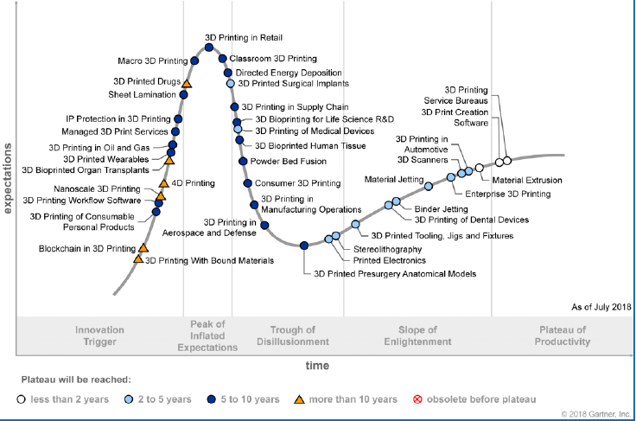
You can see precisely how each technology associated with additive manufacturing is in a specific stage of development. Some are in their initial stages, others are already falling short of the expectations generated, while there are still others that are on their way to entering the production dynamic to generate innovation.
Innovation as a continuous process
Since talking about 3D printing is usually associated with the concept of innovation, it is interesting to stop and reflect on its meaning. One way to define innovation is by referring to all change. Not only technological, based on knowledge, not only scientific, that generates value, not only economic. With a statement like this it seems that we are not defining anything, because the meaning of innovation is greatly expanded, but in reality it includes the three key words: change, knowledge and value. If the three are not present, there is no innovation. Therefore, it is a process in which new things are introduced with which existing elements are modified in order to improve them or make them more efficient. Similarly, it is also possible to implement completely new solutions with which we generate value.
INNOVATION IS ALL CHANGE, NOT JUST TECHNOLOGICAL, BASED ON KNOWLEDGE, NOT JUST SCIENTIFIC, THAT GENERATES VALUE, NOT JUST ECONOMIC
This new “something” that appears is a driving force for innovation, and throughout history we have seen it on multiple occasions. Vacuum cleaners, for example, went from being heavy, manual wooden and leather devices to the machines we know today: light, very powerful, without the need to be connected to the current and even autonomous. And all this in a time span of 50 years: less than a human lifetime.
Time and speed: a key factor in innovation
This brings us to a new variable associated with innovation, which is time. Nowadays, changes are happening faster and faster. Additive manufacturing is a very new technology, only around 30 years old, during which time it has become increasingly competitive. And this speed forces us to change the way we see and integrate innovation: it must be part of the day-to-day life of organizations, not be one-off or associated with a fad. In fact, innovation does not even require creating something completely new. If we think of the steel that makes up the body of a modern car, it is an innovation that did not exist 25 years ago, despite the fact that humans have been working with steel since the industrial revolution.
In this context, additive manufacturing appears as a new paradigm that breaks with the traditional way of manufacturing and pushes us towards the possibility of local production, in small series, with the ability to adapt very much to the needs of the customer, etc. 3D printing, therefore, is a new opportunity to innovate.
ThinkIn 3D Mataró: example of an innovative ecosystem
ThinkIn 3D Mataró is a paradigmatic example of the need to join forces and have a joint vision. From TecnoCampus and the Mataró City Council, with the decisive support of the Incyde Foundation, the accelerator is born. A facility that makes this new technology accessible to the entire local productive fabric. This is a source of wealth, not only economic, but also aimed at generating high value-added jobs. We are clear that by innovating alone we may be faster. But if we do collaborative innovation, we will go further and we will all win as a society.
We have the necessary ingredients for innovation, will you join us?
Discover the ThinkIn 3D success stories with 3D printing.
This content has been prepared based on the presentation by José María Cabrera. “Additive manufacturing and innovation: a new opportunity”, which he presented as part of the inauguration of ThinkIn 3D Mataró in March 2023.